
Every game starts as a single true thing you can stand on. For Voidfin it was this: a dark you descend into, and a small circle of light that moves with you. Everything else — the fish, the deep, the way back out — is built outward from that. This is the first entry in the devlog, and somehow there's already a game to play.
What there is to play
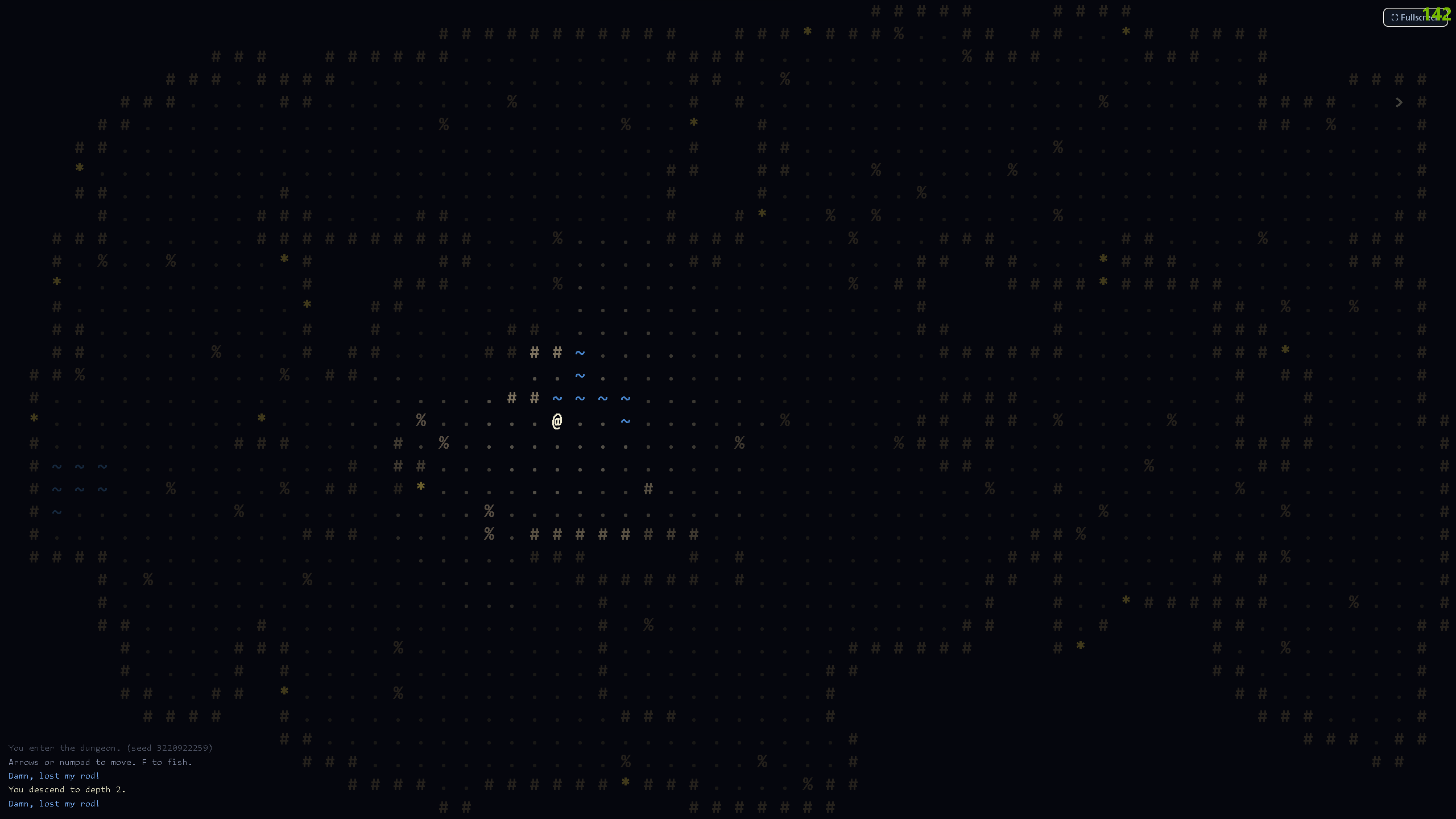
It isn't much yet, and that is entirely the point. You drop into a dungeon — caves and rooms tangled together — and you walk it by torchlight. The dark peels back as you move and remembers itself, dimly, once you've passed. Find the stairs and you descend to a fresh level. There are mineral veins in the walls, rubble underfoot, and still pools of black water you can't cross but can see across.
That's the whole game right now: a walking simulator with atmosphere. Play it here. Pay attention to that black water. It looks like decoration. It isn't.
The decisions underneath
Almost nothing here is visible, and almost all of it matters. Three calls set the shape of everything that comes after, and I'm glad we made each one early.
1. Draw on a turn, not on a clock
The obvious way to run a game is an ordinary loop: redraw everything, sixty times a second, forever. But a roguelike is turn-based — nothing moves until you do. So there is no loop. The game draws once, then sits perfectly still until you press a key. It's the single biggest reason it'll stay smooth as the levels grow heavier, and later, when fishing pauses the whole dungeon for something slow and quiet, it's why that pause costs nothing at all. The cheapest work is the work you never do.
2. Glyphs as a texture, not as text
Drawing a wall of letters straight from a font, every frame, will make a laptop without a graphics card stutter — I've watched it happen, more than once, on my own machines. So instead each letter is drawn once, in white, into a little off-screen image; then those stamps get stamped onto the screen and recoloured on the graphics card, which blits images without breaking a sweat. It's an old trick and a good one, and it means the dungeon can get as dense as it likes without the frame ever noticing.
3. Field of view by torchlight
The "seeing" is an old and rather beautiful algorithm called shadowcasting. It works out precisely what you can and cannot see from where you stand, and it runs once, on your turn, so it costs almost nothing. The atmosphere — bright at your feet, dimmer at the edges, a cold grey memory of where you've already been — isn't expensive cleverness. It's just how the result gets coloured in. Pretty, and very nearly free. Which matters more than it sounds, because in a game about the dark, what you can't see is the whole point.
In a game about the dark, what you can't see is the whole point.
A garden, not a deadline
I'm not marching this toward a release date on a calendar. It grows a little at a time, and the rule I've set myself is that it is always playable: whatever exists the day you visit, you can play. Some weeks it gains a monster. Some weeks something stranger. And because every level is grown from a seed — a single number, printed when you start — the same number always grows you the same dungeon. Handy for me when something breaks; handy for you when you find a level you love.
That black water
The pools aren't decoration — or rather, they are, for now. They're a promise. One day you'll stand at the water's edge and put a line into it, and what you pull up will be the reason you ever came down here in the first place. Today you can only look at it. But there is water, waiting, and it goes deeper than it looks.
No roadmap, remember. Next time might be a thing that moves and means you harm. It might be the rod. I'll decide partly on what you tell me — play a few seeds and let me know what felt good and what felt flat.
Either way, it exists now. A month ago it didn't. That still feels like the whole point.