
Two devlogs ago I promised a rod and gave you a puddle to look at. One devlog ago I built the pockets and the hunger you'd need for anything you caught to matter. This is the entry where the promise comes due. Stand at the edge of one of those black underground pools, press F, and for the first time your line goes into the water. Something down there is already moving.
What there is to play
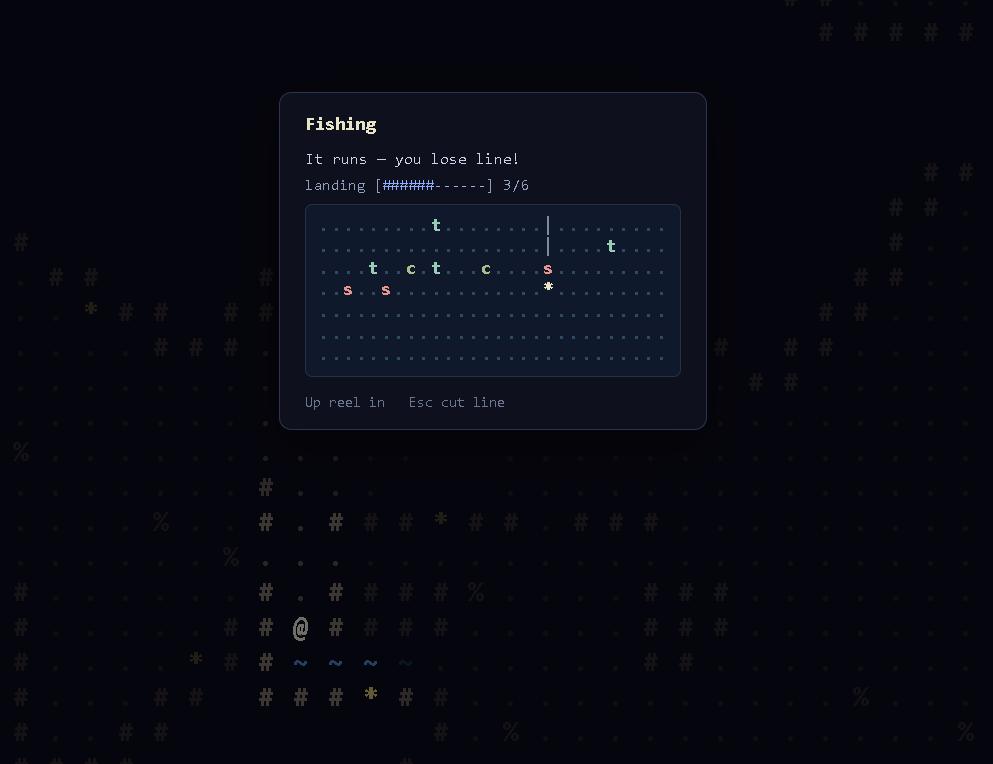
Press F beside water and the dungeon quietly steps aside for a small panel: the pool, seen edge-on, seven rows deep. Fish are drifting through it — a t for a trout up in the shallows, a c for a carp in the middling dark, an s for a salmon deeper still, each keeping to the depths it likes and wandering as it pleases.
You have two controls that matter. Left and right swing your rod, sliding the hook across the water. Up and down pay the line shallow or deep. The whole game of it is patience: read where a fish is heading, put your hook in its path at the right depth, and wait. Line one up and it takes the hook — the panel breaks into an alarm, and you have a heartbeat, four turns and no more, to strike with Enter before it spits the hook and is gone.
Strike in time and the fight begins. You reel with Up, and the fish fights back — now and then it runs, tearing line off your reel, so a landing meter that was nearly full can suddenly slip. Out-last it and it's yours: into the hold it goes. And because of the unglamorous plumbing from last time, the story doesn't end at the water — press E and you can eat what you caught. A fish is the best meal in the dungeon, and down here, with your belly ticking down every step, that is no small thing.
Where this came from
Here's the surprising part. The fishing didn't come from the roguelike at all. It came from NetHook — the larger game Voidfin shares a world with, still back in the workshop, that trades dungeons for deep space and, of all the unlikely things, is partly about casting a line where you'd least expect to find water. I'm not going to say much about it yet. But it's real, it's being built, and there'll be a good deal more to say later this year.
What I did here was reach into that project, lift the fishing out whole, and drop it into Voidfin. And the reason it's worth an entry rather than a footnote is how little that cost — and why.
Why it moved almost for free
I braced for a fight. Taking a mechanic out of one game and dropping it into another sounds like the kind of job that eats a weekend and half your patience. It didn't. It was nearly a transcription. And the reason is the single most useful thing in this whole devlog, so let me say it plainly:
The fishing has no timers, no physics, no frames. It is nothing but whole numbers on a grid, changing one turn at a time. And code shaped like that will go almost anywhere you want it to.
Think about what usually makes a mechanic hard to move house. It's the frame-rate-dependent bits — the smooth motion, the physics, the this-many-pixels-per-second that assumes a particular engine and a particular clock. The fishing has none of that. A fish is at column 11, row 4. A hook is at column 12, row 4. Are they close enough to bite? That's a comparison of two integers. The mechanic is a little state machine — waiting for a bite, then a bite you must answer, then the winding fight — and it takes exactly one discrete step each time you press a key, which is precisely how the dungeon above it already worked. The two halves of the game keep the same heartbeat. That's not luck; it's the whole reason turn-based, integer-state design is worth loving. It travels.
The bug worth confessing
There was a lovely, instructive one. Two different bits of the code each worked out which column the hook was in — one to decide whether a fish was biting, the other to actually draw the hook on screen. They disagreed by a column. So fish would "bite" in a spot where you could plainly see no hook at all: maddening, and completely invisible until you stared at it.
The fix is a rule I should have followed from the start and now follow everywhere: work a thing out in one place, and have everyone ask that one place. One function decides where the hook is. The sim and the picture both call it. They cannot disagree, because there's no longer two of them to disagree.
Something that shouldn't be down there
One last thing, and then I'll let you fish. Keep your line deep, and be patient, and very occasionally you'll pull up something the guidebook has no name for — something that has no business swimming in a dungeon pool, or perhaps anywhere. I've said too much already. Fish the deep water and see for yourself.
No roadmap, as ever. But the water works now, and there's a fish frying, and a month ago there was neither. Go on — F, and mind the deep.