
Last time I left you at the edge of some black underground water with a promise: one day you'd fish it. I sat down fully meaning to build that. And then I hit the least glamorous wall in game design, the one that stops you before every good idea: if you catch a fish — where does it go? You can't land a thing you have nowhere to put. And even if you could keep it, why would you bother, if it did nothing?
A fish you can't carry and don't need isn't a mechanic. It's a decoration that smells. So this entry isn't about the rod after all. It's about pockets, and about being hungry enough to care what's in them. It's the plumbing under the pretty part — and, as usual, the plumbing turned out to be the whole job.
What there is to play
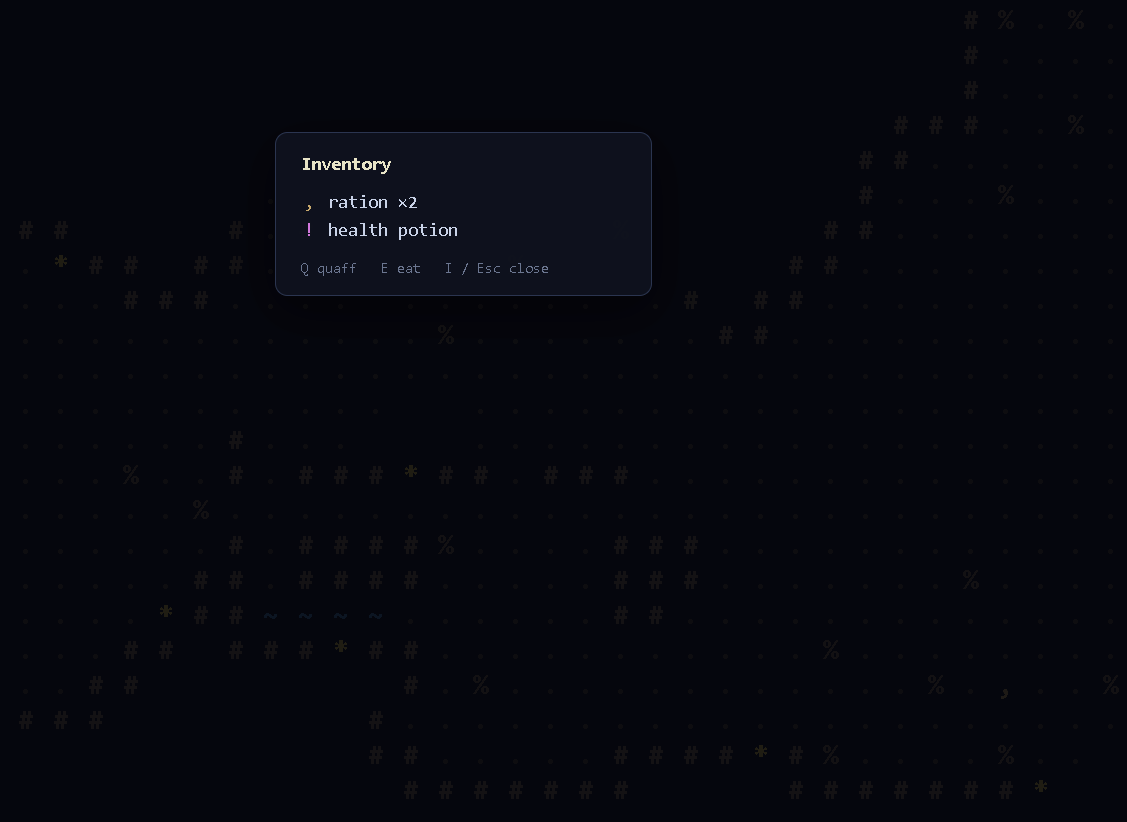
Scattered on the dungeon floor now are things worth stooping for. A ! is a health potion; a , is a ration of food. Walk over one and it's yours — no fumbling with a pickup key, you just take it, and the log tells you so. Press I to see what you're carrying. Press Q to quaff a potion and get some health back. Press E to eat.
And here is the part that makes the rest mean anything: you now get hungry. Every step you take, a little of your belly empties — up in the corner you'll see your food tick down. Let it hit zero and the dungeon starts eating you instead, a point of health at a time, until you find something to eat or you don't, and die of it. Permadeath was always the promise; now there's a second, slower way for the dark to keep you.
Three decisions I'm glad we made
1. Items are a list, not a language
Every item in the game — every potion, every ration, and soon every fish — is a single line in one small catalogue: what it looks like, what kind of thing it is, and what it does when you use it. Adding a brand-new item is adding one line; nothing else in the game needs to be told it exists. That sounds like a tidiness thing, and it is, but it's really a speed thing. When the whole plan is to grow the game a little at a time, the cost of planting one more seed has to stay near zero. This is how you keep it there.
2. Pick it up by walking on it
There's an old roguelike habit of standing on an item and pressing a key to pick it up. I threw that out. You walk onto a thing, it goes in your pack, the log murmurs what you got. One less key between you and the game. The dungeon has enough friction in it already — I want all of that friction to be the interesting kind, the kind you chose, not the kind the interface charged you.
3. Hunger is the point of food
It would have been easy to add rations and stop there — free health-adjacent snacks, why not. But food with no hunger is a reward with no question attached, and a reward with no question is just clutter. The hunger clock is what turns a ration from litter into a decision: eat now, or push one more room deeper and hope? It costs almost nothing to run — one subtraction, once a turn — and it buys the single most valuable thing a game can have, which is a reason to hesitate.
Food with no hunger is a reward with no question attached — and a reward with no question is just clutter.
The rule I should have started with
One thing worth admitting, because it's the kind of small wrongness that only shows up when you play. My first cut let you happily quaff a ration and eat a potion. Nothing broke; it just felt absurd, glugging a fish fillet. The fix was to give every item a kind, and let the verb check the kind before it does anything — you can only quaff a potion, only eat food. A tiny change. But "nothing broke, it just felt wrong" is exactly the sort of judgement that is the job, so I'd be a fraud not to show you one.
So — the rod?
Now you have somewhere to put a fish, and a stomach with an opinion about whether you find one. Which means the groundwork is finally done. The black water is open for business at last — but the fishing turned out to be the most surprising thing I've built here, and it came from a strange direction. That's the next entry.
For now: go and get hungry. Then go and stand by the water. You'll find, this time, that pressing F does rather more than it used to.